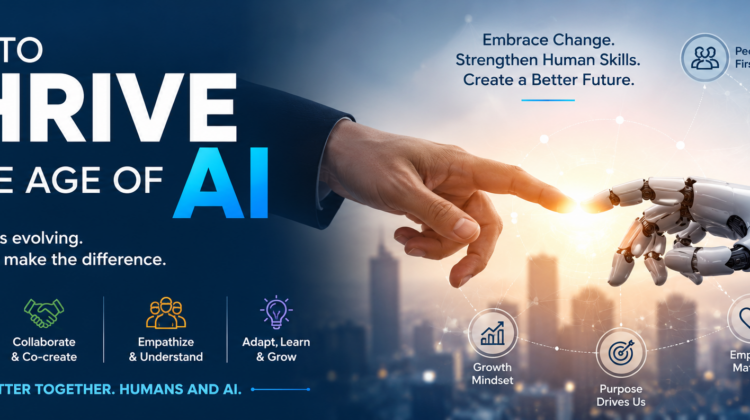
To thrive in the age of AI, we need to learn how to work effectively with both humans and machines.
Most importantly, we must focus on the human side of work.
According to one estimate, success at work has traditionally been 75% communication and relationship-building, and only 25% technical expertise.
With the rise of AI, that balance is shifting even further. In many roles, human skills now account for 85% of success, while technical skills make up only 15%.
To succeed in this new era, we must adapt to the changes brought by AI and strengthen our soft skills.
The challenge is that while technology has made communication easier, it has not necessarily improved connection.
AI is growing rapidly, and it is here to stay. Yet our connections with other human beings are becoming more fragile. We are losing the ability to build meaningful relationships.
Connection is a skill. Like any skill, if we do not practice it, it weakens over time.
So, how do we navigate disagreements and work better with others?
Here are four principles to improve your human skills in the age of AI.
1. Seek Understanding, Not Just Agreement
Imagine you are participating in a debate competition. Based on a coin toss, you might have to argue either for or against a topic.
Life works the same way.
When someone challenges your point of view, try to understand their perspective rather than immediately defending your own.
The goal is not to agree with every opinion. The goal is to understand it.
We are often taught to win arguments and convince others. Instead, we should focus on understanding how others see the world.
When we do that, we become more persuasive, more empathetic, and more effective collaborators.
Approach conversations with curiosity rather than judgment.
AI can help with this. Whenever you disagree with someone, ask AI to explain the other person’s perspective. It can help you see the issue from different angles.
2. Expand the Pie
Think beyond win-or-lose situations. Look for win-win outcomes.
I once negotiated with a shopkeeper, and we could not agree on the price. Instead of continuing to bargain, I asked myself, “What else is possible?”
I offered to recommend his shop to my friends if he could lower the price. He agreed.
I bought the product at a fair price, and later I brought my friends to his store.
We both benefited.
Too often, we approach life with a win-lose mindset. But most successful relationships are built on mutual value.
Expanding the pie means creating opportunities where everyone gains.
This mindset transforms competition into collaboration.
Instead of asking, “How can I win?” ask, “How can we create more value together?”
3. Diversify Your Circles
Surround yourself with people who think differently from you.
Build relationships with people from different backgrounds, cultures, professions, beliefs, and experiences.
Diverse teams create stronger ideas and better solutions because they bring multiple perspectives to the table.
There is a saying: “Show me your friends, and I’ll show you your future.”
Actively seek new connections, especially with people outside your usual circles.
Find common ground despite your differences. Those shared interests become the foundation for meaningful relationships.
4. Show That You Care
People remember how you make them feel.
Offer a helping hand. Listen carefully. Support others, even when it requires extra effort.
If someone is preparing a presentation, help them. Understand their goals and encourage their ambitions.
Show genuine interest in their success.
At the end of the day, people want to feel heard, understood, and appreciated.
When people feel valued, teams thrive. When they feel ignored, teams break apart.
Reach out to someone. Check in on them. Make time to connect.
In the age of AI, technical skills will continue to evolve, but human connection will always matter.
Build the muscles that allow you to work effectively with both people and machines.