• Skip to main content
  • Skip to primary sidebar
  • Home
  • About
  • Recommended Readings
    • 2022 Book Reading
    • 2023 Recommended Readings
    • Book Reading 2024
    • Book Reading 2025
    • Book Reading 2026
  • Supply Chain Management Guide
  • PKM
  • Microsoft Excel
  • Microsoft Copilot in Office 365
  • Public Wiki Page

Ali Raza Zaidi

A practitioner’s musings on Dynamics 365 Finance and Operations

ChatGPT

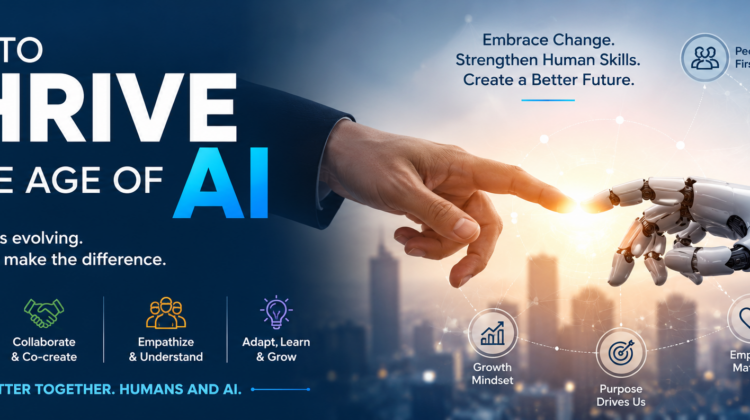
Thriving in the Age of AI: Strengthening Human Skills

June 17, 2026 by alirazazaidi

To thrive in the age of AI, we need to learn how to work effectively with both humans and machines.

Most importantly, we must focus on the human side of work.

According to one estimate, success at work has traditionally been 75% communication and relationship-building, and only 25% technical expertise.

With the rise of AI, that balance is shifting even further. In many roles, human skills now account for 85% of success, while technical skills make up only 15%.

To succeed in this new era, we must adapt to the changes brought by AI and strengthen our soft skills.

The challenge is that while technology has made communication easier, it has not necessarily improved connection.

AI is growing rapidly, and it is here to stay. Yet our connections with other human beings are becoming more fragile. We are losing the ability to build meaningful relationships.

Connection is a skill. Like any skill, if we do not practice it, it weakens over time.

So, how do we navigate disagreements and work better with others?

Here are four principles to improve your human skills in the age of AI.

1. Seek Understanding, Not Just Agreement

Imagine you are participating in a debate competition. Based on a coin toss, you might have to argue either for or against a topic.

Life works the same way.

When someone challenges your point of view, try to understand their perspective rather than immediately defending your own.

The goal is not to agree with every opinion. The goal is to understand it.

We are often taught to win arguments and convince others. Instead, we should focus on understanding how others see the world.

When we do that, we become more persuasive, more empathetic, and more effective collaborators.

Approach conversations with curiosity rather than judgment.

AI can help with this. Whenever you disagree with someone, ask AI to explain the other person’s perspective. It can help you see the issue from different angles.

2. Expand the Pie

Think beyond win-or-lose situations. Look for win-win outcomes.

I once negotiated with a shopkeeper, and we could not agree on the price. Instead of continuing to bargain, I asked myself, “What else is possible?”

I offered to recommend his shop to my friends if he could lower the price. He agreed.

I bought the product at a fair price, and later I brought my friends to his store.

We both benefited.

Too often, we approach life with a win-lose mindset. But most successful relationships are built on mutual value.

Expanding the pie means creating opportunities where everyone gains.

This mindset transforms competition into collaboration.

Instead of asking, “How can I win?” ask, “How can we create more value together?”

3. Diversify Your Circles

Surround yourself with people who think differently from you.

Build relationships with people from different backgrounds, cultures, professions, beliefs, and experiences.

Diverse teams create stronger ideas and better solutions because they bring multiple perspectives to the table.

There is a saying: “Show me your friends, and I’ll show you your future.”

Actively seek new connections, especially with people outside your usual circles.

Find common ground despite your differences. Those shared interests become the foundation for meaningful relationships.

4. Show That You Care

People remember how you make them feel.

Offer a helping hand. Listen carefully. Support others, even when it requires extra effort.

If someone is preparing a presentation, help them. Understand their goals and encourage their ambitions.

Show genuine interest in their success.

At the end of the day, people want to feel heard, understood, and appreciated.

When people feel valued, teams thrive. When they feel ignored, teams break apart.

Reach out to someone. Check in on them. Make time to connect.

In the age of AI, technical skills will continue to evolve, but human connection will always matter.

Build the muscles that allow you to work effectively with both people and machines.
GPTs that Every D365 Finance and Operation Consultant Must use

April 17, 2026 by alirazazaidi

There are many GPTs available that are specifically trained to help answer different types of questions.

Some of these GPTs are focused on Dynamics 365 Finance & Operations, helping with areas like X++, functional processes, troubleshooting, and solution design. For example, GPTs like D365F&O-GPT are built to act as experts for Finance & Operations queries.

You can also build and share your own GPTs, but this requires the Pro version of ChatGPT.

These GPTs become more useful over time as people continue to use and interact with them. In fact, similar AI assistants are being developed specifically for the D365 ecosystem to provide faster and more reliable guidance by combining documentation, best practices, and real-world experience.

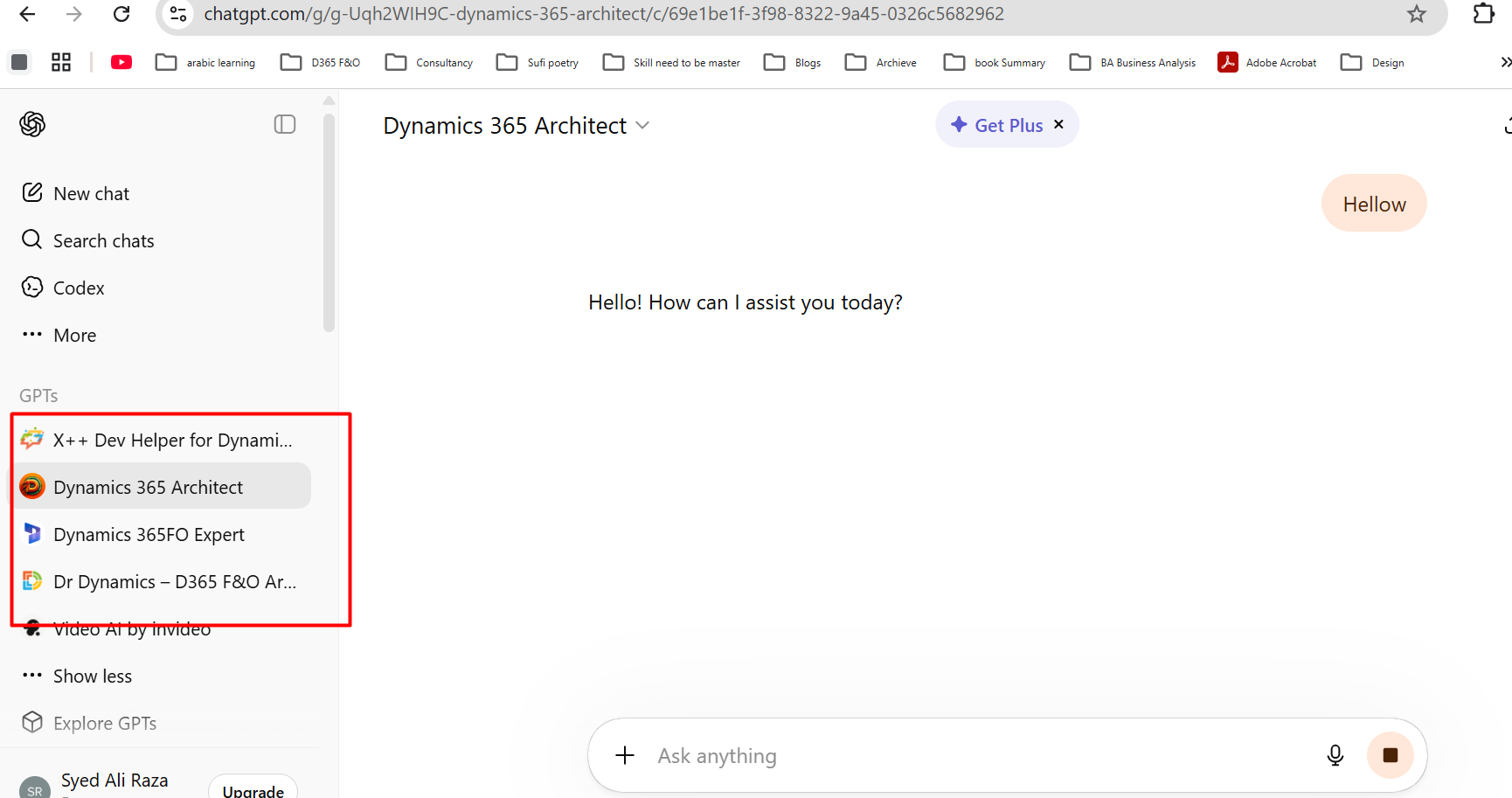
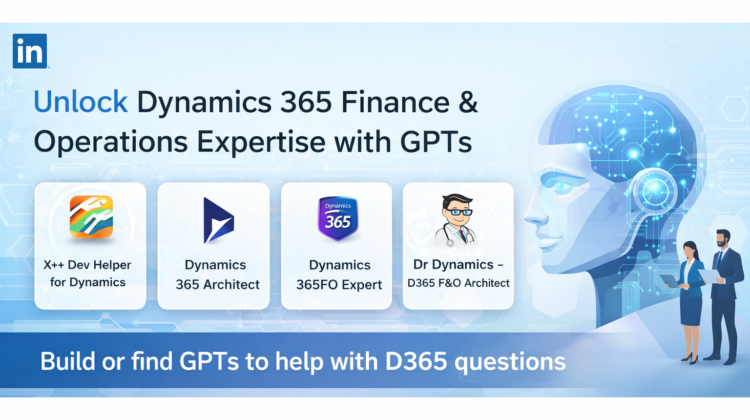
Personally, I use these four GPTs related to Dynamics 365 Finance & Operations. You can search for them, try them out, and explore others as well—new ones are being added by the community every day.

  • X++ Dev Helper for Dynamics
  • Dynamics 365 Architect
  • Dynamics 365FO Expert
  • Dr Dynamics – D365 F&O Architect

Lets do a better prompt

April 14, 2026 by alirazazaidi

I am using AI since 2023. Many times I think, I could deliver better if I had these tools couple of years back.

But second time is now.

Here are my notes for Prompot Engineering. And why it is called engineering.

A prompt typically has three main parts:

  1. Top (Role & Output Expectation)
    Define the role you want the AI to take and specify the type of output you expect.
  2. Middle (Task & Context)
    Clearly describe the task and provide the necessary background or context.
  3. Bottom (Format & Constraints)
    Specify how the response should be structured (e.g., bullet points, paragraphs) and include any constraints such as word limits or tone.

Why is it called Prompt Engineering?
Because it is a structured approach to problem-solving. You are designing inputs in a deliberate way to get precise and useful outputs.


Types of Prompts

  1. Zero-Shot Prompting
    No examples are provided. The model relies entirely on the instructions.
  2. Few-Shot Prompting
    Includes examples and reasoning to guide the model toward the desired output.

Primary Sidebar

About

I am Dynamics AX/365 Finance and Operations consultant with years of implementation experience. I has helped several businesses implement and succeed with Dynamics AX/365 Finance and Operations. The goal of this website is to share insights, tips, and tricks to help end users and IT professionals.

Legal

Content published on this website are opinions, insights, tips, and tricks we have gained from years of Dynamics consulting and may not represent the opinions or views of any current or past employer. Any changes to an ERP system should be thoroughly tested before implementation.

Categories

  • Accounts Payable (2)
  • Advance Warehouse (2)
  • AI (3)
  • Asset Management (3)
  • Azure Functions (1)
  • Books (6)
  • Certification Guide (3)
  • ChatGPT (3)
  • Claude (1)
  • Customization Tips for D365 for Finance and Operations (64)
  • D365OF (60)
  • Data Management (1)
  • database restore (1)
  • Dynamics 365 (59)
  • Dynamics 365 for finance and operations (139)
  • Dynamics 365 for Operations (175)
  • Dynamics AX (AX 7) (134)
  • Dynamics AX 2012 (274)
  • Dynamics Ax 2012 Forms (13)
  • Dynamics Ax 2012 functional side (16)
  • Dynamics Ax 2012 Reporting SSRS Reports. (31)
  • Dynamics Ax 2012 Technical Side (52)
  • Dynamics Ax 7 (65)
  • Exam MB-330: Microsoft Dynamics 365 Supply Chain Management (7)
  • Excel Addin (1)
  • Favorites (12)
  • Financial Modules (6)
  • Functional (8)
  • General Journal (1)
  • Implementations (1)
  • Ledger (1)
  • Lifecycle Services (1)
  • Logseq (4)
  • Management Reporter (1)
  • Microsoft Excel (4)
  • MS Dynamics Ax 7 (64)
  • MVP summit (1)
  • MVP summit 2016 (1)
  • New Dynamics Ax (19)
  • Non Defined (9)
  • Note taking Apps (2)
  • Obsidian (4)
  • Personal Knowledge Management (3)
  • PKM (16)
  • Power Platform (6)
  • Procurement (5)
  • procurement and sourcing (6)
  • Product Information Management (4)
  • Product Management (6)
  • Production Control D365 for Finance and Operations (10)
  • Sale Order Process (10)
  • Sale Order Processing (10)
  • Sales and Distribution (5)
  • Soft Skill (1)
  • Supply Chain Management D365 F&O (5)
  • Tips and tricks (278)
  • Uncategorized (165)
  • Upgrade (1)
  • Web Cast (7)
  • White papers (4)
  • X++ (10)

Wiki

  • SCM

Copyright © 2026 · Magazine Pro On Genesis Framework · WordPress · Log in